
Imagine a water treatment facility that has successfully passed its cybersecurity assessment. Policies are approved, asset inventories are maintained, firewall diagrams are documented, and every compliance dashboard shows green.
Yet after a project cycle, an engineering workstation runs an unsupported operating system, a contractor retains unnecessary remote access, and a temporary firewall rule introduced during commissioning remains active.
The facility may be compliant on paper, but is it secure where it matters?
This is the challenge facing many industrial organizations: OT cybersecurity compliance demonstrates alignment with requirements, while operational security demands evidence that safeguards actually reduce risk.
The OT Compliance Gap: Documentation vs. Reality
Standards and frameworks such as ISA/IEC 62443, Saudi Arabia’s NCA OTCC-1:2022, and NIST SP 800-82 provide essential direction for protecting Operational Technology (OT) environments.
However, satisfying a documentation requirement does not automatically establish that a security control is effective.
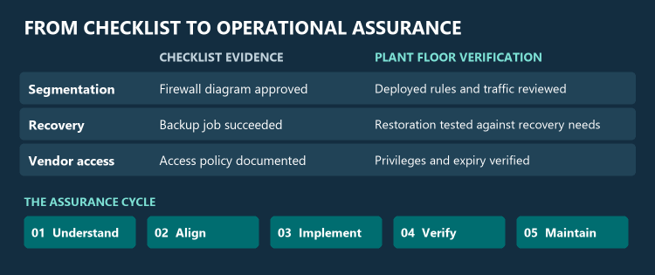
Consider network segmentation. An approved architecture may illustrate isolated OT zones protected by firewalls. But if the deployed configuration permits unrestricted communication between those zones, the intended protection is compromised.
Similarly, a successful backup notification does not prove that a SCADA server can be restored within an acceptable recovery period.
The distinction is simple:
A control must be implemented, verified, and maintained, not merely documented.
OT Security Must Respect Operational Reality
Industrial systems cannot always accommodate conventional IT security practices.
An enterprise workstation may be restarted for patching with limited consequences. Restarting a critical HMI or engineering station during production could interrupt visibility, delay operator response, or affect plant availability.
Likewise, aggressive session timeouts, untested endpoint agents, or intrusive vulnerability scans can introduce operational risks.
NIST SP 800-82 Rev. 3 emphasizes that OT security must account for safety, reliability, and performance requirements.
This does not justify ignoring security controls. It requires engineering them appropriately.
For example, where a legacy controller cannot be patched immediately, organizations may implement restricted communication paths, controlled access, enhanced monitoring, and a documented replacement strategy.
Such measures should be evaluated against the actual risk and should not be assumed equivalent to patching.
The objective is not to force every IT control into OT, but to achieve each control’s security purpose without compromising the industrial process.
OT Security Evidence Should Prove Effectiveness, Not Just Existence
A screenshot showing an installed security application proves very little about its effectiveness.
Consider application allowlisting. An assessment should establish whether the solution is deployed to relevant endpoints, configured in the intended enforcement mode, and capable of preventing unauthorized execution.
The same principle applies across critical OT controls:
Control | What meaningful verification looks like |
Network segmentation | Reviewing actual firewall rules and permitted traffic flows |
Asset management | Reconciling inventories against discovered and installed assets |
Backup and recovery | Validating restoration through controlled, approved testing |
Access management | Reviewing privileges, shared accounts, and expired vendor access |
Security monitoring | Confirming relevant alerts reach responsible personnel and are investigated |
Verification must itself be safe. Passive monitoring, configuration reviews, maintenance records, and vendor-approved testing are often preferable to intrusive testing on live systems.
A Practical Example: Securing an Unpatchable OT Engineering Workstation
Consider an engineering workstation supporting a critical PLC system.
Its operating system is no longer supported, but upgrading it could make the engineering software incompatible with the controller.
A checklist identifies missing patches. A risk-based assessment goes further.
It examines whether the workstation has internet connectivity, who can access it, which systems it communicates with, whether removable media is controlled, and what safeguards limit potential compromise.
The organization can then establish compensating controls and a modernization plan based on operational feasibility.
Importantly, accepting a risk is not the same as mitigating it. Residual exposure must be understood, approved by the appropriate risk owner, and reviewed as conditions change.
Effective compliance turns findings into defensible engineering decisions, not just closed audit observations.
OT Compliance Requires Engineers and Operators at the Same Table
A cybersecurity team may recommend disabling an insecure protocol without realizing that a critical industrial application depends on it.
An operations team may request unrestricted vendor access to simplify maintenance without understanding the resulting security exposure.
Neither perspective alone provides the complete answer.
OT cybersecurity requires collaboration between security professionals, automation engineers, plant operators, maintenance teams, and equipment vendors.
This is particularly important during commissioning, maintenance shutdowns, configuration changes, and system upgrades.
Security requirements should be considered throughout the system lifecycle, rather than introduced only when an assessment is approaching.
Moving from OT Compliance to Operational Assurance
A mature OT security program should connect regulatory requirements with measurable operational outcomes.
A practical approach involves five activities:
- Understand: Identify assets, communication paths, critical processes, dependencies, and consequences of failure.
- Align: Map applicable requirements to the actual industrial environment and its risk profile.
- Implement: Deploy technically appropriate safeguards, including compensating measures where justified.
- Verify: Confirm intended operation using reliable evidence and testing methods suitable for production environments.
- Maintain: Reassess controls after changes, review exceptions, monitor effectiveness, and address emerging risks.
This approach is consistent with the risk-based principles underlying established OT cybersecurity guidance.
It also changes the questions organizations ask.
Instead of asking “Do we have a firewall?” ask “Does it enforce the intended communication restrictions?“
Instead of asking “Are backups configured?” ask “Can we recover the critical system when needed?“
And instead of asking “Did we pass the audit?” ask “What evidence demonstrates that our industrial operations are better protected?“
Conclusion: The Plant Floor Is the Real Test
Compliance frameworks establish necessary expectations, but cybersecurity maturity depends on how effectively those expectations are translated into operational safeguards.
A successful audit is valuable. It is not a guarantee of security, nor is it the end of the process.
When a cyber incident occurs, the plant will not be protected by the number of green cells in a compliance spreadsheet. Protection will depend on the security controls that actually work.
That is where OT compliance must prove its value.
Ready to Verify Your OT Security Controls?
Is your OT environment truly secure, or just compliant on paper? Talk to ACET Solutions’ OT cybersecurity specialists about turning ISA/IEC 62443 and NCA OTCC requirements into controls that work on your plant floor. Contact our team to schedule a consultation, or explore our OT cybersecurity services.
About ACET Solutions
ACET Solutions is a global operational technology (OT) cybersecurity company dedicated to protecting the industrial systems that power critical infrastructure worldwide.
With decades of specialized experience and a team of certified engineers, we delivers end-to-end OT security services, from governance and risk assessments to technical implementation and managed security operations, across sectors including oil & gas, electrical and utilities, water, petrochemicals, marine and ports, mining, healthcare, and manufacturing. Learn more at ACET Solutions
About Avanceon
Avanceon is a leading provider of industrial automation process control systems integration proprietary energy management solutions and support services. Avanceon has a strong global footprint with operations across the Middle East including the United Arab Emirates Qatar and Saudi Arabia as well as Southeast Asia and Australia.
With a legacy in the automation industry dating back to 1984 Avanceon has evolved into a 360-degree solutions provider delivering automation energy management service and maintenance solutions to major blue-chip companies. Avanceon is also listed in Control Engineering Magazine’s System Integrator Hall of Fame. Learn more at Avanceon
